Tense Rivals: The Tenses Your Students Always Mix Up

Most tense mistakes do not happen inside one tense. They happen at the border between two. A student knows the simple past and knows the present perfect, and still says "I have seen that movie yesterday." Tense Rivals is a new grammar series built for that border. Each set puts two tenses on one screen and asks students to choose.
Three Rivalries to Start
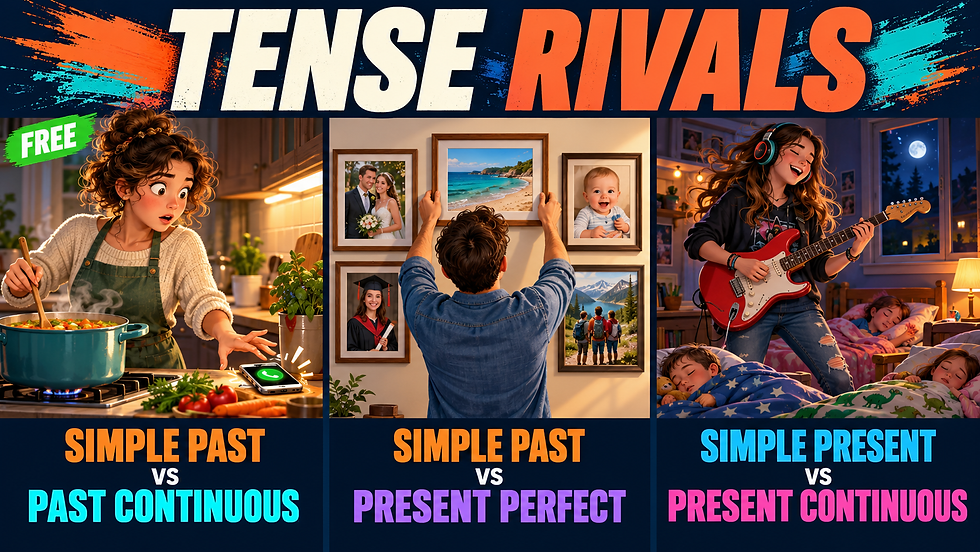
Three sets are live: Simple Past vs Past Continuous, Simple Past vs Present Perfect, and Simple Present vs Present Continuous. Simple Past vs Past Continuous is free and opens without an account. The other two are for Cool English subscribers. Each set holds eight or nine activities plus a printable worksheet, and the art changes from activity to activity so no two screens feel the same.
What Every Set Shares
Every set opens with The Rules, one screen with both tenses side by side: the form, three common uses, and a color for each tense that follows students through the whole set. Rewrite lets students flip a sentence between the two tenses, and between positive, negative, and question forms, with a single switch. Movie Clips plays short scenes from real films; students say the missing verb out loud, then tap the gap to check. A ten-question listening challenge, called The Call in two sets and The Alibi in the third, has students hear a question and answer it in a full sentence. Each set closes with a Final Test and the worksheet.
What Makes Each Set Different
The three sets follow the same path, but none of them is a copy of the others. In Simple Present vs Present Continuous, Something's Different shows a school on an unusual day. Students read what normally happens, then spot what is different today, like the janitor who normally cleans the hall sitting on his cart playing guitar. In Simple Past vs Present Perfect, Legends puts two famous singers side by side, one still performing and one who has passed away, and students decide which one "has sung" and which one "sang." In Simple Past vs Past Continuous, Story Mode plays a short scene and stops right at the interruption.
Where the Speaking Happens
Almost every activity asks for an answer out loud before anything appears on screen. Picture the Story Mode scene: a man is in the shower, and the picture freezes. The class builds the first half together: he was taking a shower. Then comes the real question. What happened? One student says the doorbell rang. Another says the water went cold. Now there are two stories on the table, and the class has to defend one. The Reveal button comes after the argument, not before it.
Present, Practice, Produce
Each set follows a familiar lesson shape. The Rules presents both tenses. The middle activities give practice with support from pictures, audio, color, and reveal buttons. The listening challenge, the Final Test, and the worksheet ask students to produce the tenses with much less help. Open a set on the classroom screen, work through the first activities together, and assign the rest for homework. Print the worksheet when you want something on paper. Pick the rivalry your students mix up most and start with The Rules.


Comments