Compliment and Complain — Google Reviews of Real Places

Praise and Complain — Google Reviews of Real Places
Students already know the situation. They are choosing a restaurant, looking for a hotel, or deciding whether a tourist attraction is worth the time, the money, or the long line.
That is exactly the English they meet outside the classroom.
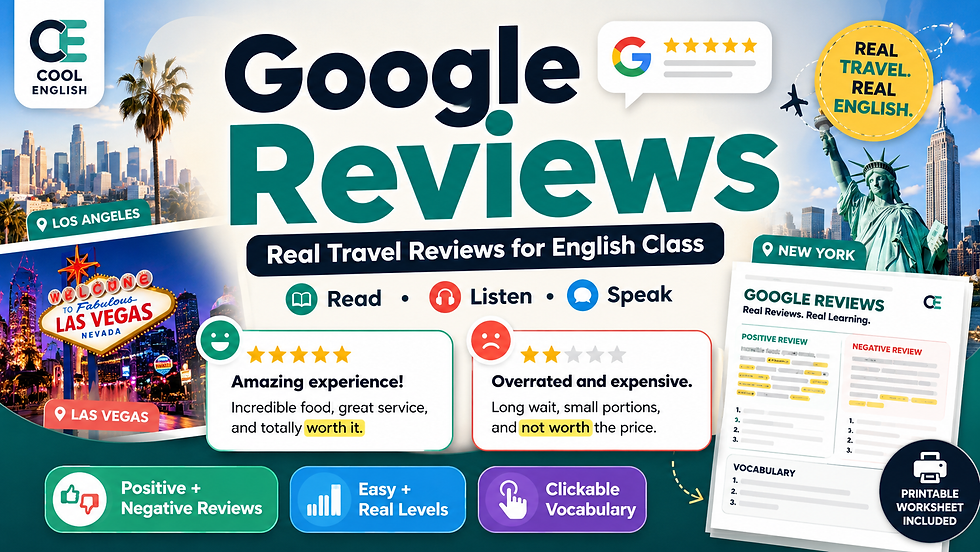
This week on Cool English we are launching Google Reviews, a reading and listening activity built around real-world reviews of well-known places in cities such as New York, Los Angeles, and Las Vegas.
What's new
Each city features four places: a restaurant, a hotel, a shopping area, and a tourist attraction.
Every place comes with one positive review and one negative review, and each review is available at two levels: Easy and Real. That means the same place can work for a lower-level group, a stronger group, or a mixed class.
How it works
Open a place and choose Positive, Negative, or Read Both.
Students read the review, listen to it read aloud, and click or tap any highlighted word to see a short definition, the word in its original sentence, and an audio model.
The New York set, for example, opens with Katz’s Deli. The positive review calls the pastrami “tender” and “worth every penny,” while the negative review calls the same place a “madhouse” and a “tourist trap.”
Same restaurant. Opposite verdicts.
Why it works
Reviews put evaluative language in context.
A student does not just learn words like overrated, steep, or worth every penny from a list. They meet the words inside a real opinion, next to the positive or negative version of the same experience.
Reading the two reviews side by side makes the vocabulary of praise and complaint concrete. It also gives students a reason to take a side:
Would you still go?Was the complaint fair? What makes a review convincing?
A simple routine
Read the positive review.Read the negative review. Choose the three details that matter most. Then decide:
Would you go there, and why?
Each review ends with discussion questions, so the reading naturally turns into speaking. Students compare opinions, defend their choices, and use the vocabulary from the text to explain their thinking.
Worksheet included
Every place comes with a printable worksheet: both reviews on one page, discussion questions, and a glossary of the highlighted words.
Use it after the digital activity, or start with the worksheet and use the screen for listening, pronunciation, and vocabulary support.
Google Reviews gives students practical travel English they can actually use: how to recommend a place, complain about a bad experience, describe service and prices, and decide whether something is really worth it.


The ragdoll movement makes every fight feel a little different. I missed an easy shot earlier, then somehow landed a much harder one in ragdoll archers.
I opened Block Blast after replacing an empty roll of paper towels. It felt like a small task deserved a small reward.